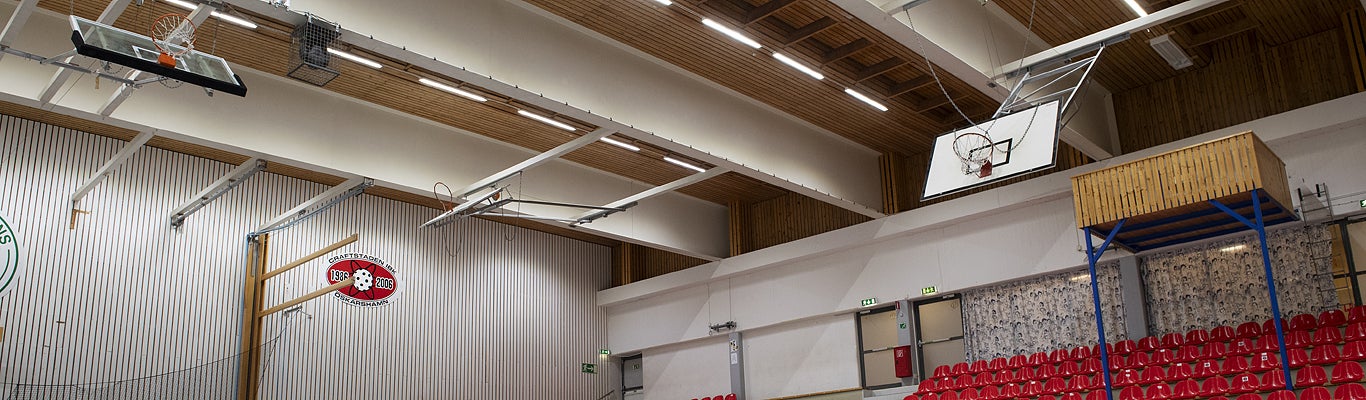
Sports Hall Lighting for Sports Facilities
Professional lighting in a sports hall must meet the needs of many different users, from school sports in the morning to elite training and competitions in the evening. The right lighting creates good visual comfort, allowing athletes to quickly track balls and teammates in motion without being exposed to glare. Investing in robust and energy-efficient luminaires helps create a safe training environment while keeping the facility's operating and maintenance costs under control.
What Are the Requirements for Functional Sports Hall Lighting?
Lighting in sports halls is exposed to extreme conditions and places specific demands on the construction and optics of the luminaires. Impact resistance is essential – the equipment must withstand hard ball impacts without breaking or creating a safety hazard. At the same time, glare control is a key factor, as athletes in sports such as badminton, volleyball and basketball often look directly towards the ceiling. With smart zone and scene control, light levels can easily be adjusted depending on whether the hall is being used for school sports, cleaning or a match requiring particularly high and uniform illumination.
Tailored Lighting Solutions for Sports and Athletic Facilities
To accommodate all types of activities in a sports facility, a flexible range of robust luminaires and intelligent lighting control systems is required.
Ceiling-mounted luminaires: Glare-free luminaires that distribute light evenly throughout the hall and are designed to withstand powerful ball impacts without damage.
Lighting control: Smart control units with motion sensors that automatically switch the lighting on or off when someone enters or leaves the hall.
Sealed luminaires: Even and comfortable lighting for changing rooms, spectator stands and adjacent corridors that can withstand moisture and continuous use.
Frequently Asked Questions About Sports Hall Lighting
How Can Glare Be Prevented in a Sports Hall?
Using luminaires with good glare control and advanced prismatic optics helps distribute light smoothly across the playing area. Correct positioning of the luminaires in relation to the court markings is also essential to prevent athletes from being dazzled when looking up at high balls.
H3 What Does It Mean for a Luminaire to Be Ball Impact Tested?
A ball impact-tested luminaire has undergone testing to ensure that it can withstand repeated and powerful impacts from balls, such as handballs travelling at high speed, without components becoming detached or breaking. This helps maintain safety in the sports hall.
What Light Level (Lux) Is Recommended in a Sports Hall?
Requirements depend on how the facility is used. For school sports and recreational activities, 300 lux is often sufficient, while training and higher-level league competitions typically require 500 lux. For elite sports or televised matches, requirements may increase to 750 lux or more, with high requirements for uniformity and colour rendering.