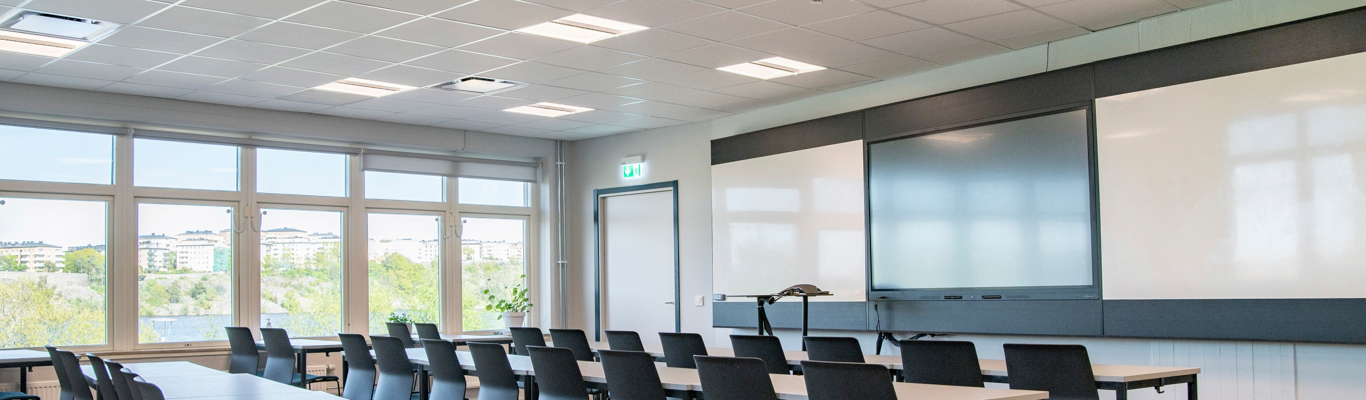
Lighting for schools
Aura Light manufactures classroom luminaires suitable for a wide range of educational environments, including libraries, dining halls, and gymnasiums. We have always focused on long service life, low energy consumption, and light quality suited to educational environments. Our goal is to deliver a complete, flexible, and adaptable solution, from LED panels in classrooms to spotlights in common areas.
What is school lighting?
School lighting is a collective term for the systematic planning and installation of lighting in educational environments. It is a specialized branch of lighting design that goes far beyond simply mounting luminaires in the ceiling. At the core of modern educational lighting is the creation of a visual environment that is safe, comfortable, and adapted to educational activities.
Choosing the right luminaires—such as LED luminaires or linear fixtures—and placing them correctly is essential to achieve uniform light distribution without disturbing glare. A critical metric in this context is the UGR value (Unified Glare Rating), which in classrooms should be below 19 to maintain a glare-free environment.
In addition, the lighting must provide good colour rendering (CRI/Ra) so that colours are perceived accurately, which is crucial in subjects such as art and chemistry. Today’s LED lighting for schools is often adaptable, with features such as dimming and adjustable colour temperatures, allowing the lighting to be tailored to different activities.
Why is proper lighting important in schools?
Proper lighting in schools is important because light directly affects the visual environment and the conditions for different activities within the school setting. The light we are exposed to influences how we perceive our surroundings and contributes to different lighting environments throughout the day. Old, flickering fluorescent lighting may be perceived as uncomfortable by some users, while modern, well-designed classroom lighting can contribute to good visual comfort.
Here are some of the reasons why investing in good lighting for schools pays off:
Improved concentration and learning:
Dynamic lighting, often referred to as Human Centric Lighting or Tunable White solutions, can adapt the lighting environment to different activities and usage scenarios. By using a cooler, more daylight-like light with higher intensity during lessons, students’ concentration levels and alertness can be increased. During calmer activities or breaks, the lighting can be adjusted to a warmer color temperature to create a more relaxed atmosphere. This type of adaptable lighting is used to create different lighting environments depending on the activity and intended use of the space.
Better well-being and circadian rhythm:
Human biology is closely linked to natural daylight cycles. Good school lighting may be designed with varying light levels and colour temperatures throughout the day.Flicker-free and glare-free lighting can contribute to good visual comfort.
Increased safety and visual comfort:
Proper lighting in corridors, stairwells, and other common areas is important for orientation and use of the space. Even light distribution without dark corners can improve visibility within the environment. In classrooms, the focus is on ensuring good visual conditions so that information on whiteboards or in books is easy to read from all parts of the room.
Energy efficiency and sustainability:
Replacing older lighting technologies with modern LED lighting for schools may reduce energy use depending on the installation, product selection, and operating conditions. LED light sources often have long service life, which may reduce the need for light source replacements. Combining LED lighting with occupancy sensors and daylight harvesting can adapt lighting operation to the use of the space.
Flexibility for the future of learning:
Today’s schools are not static environments. Classrooms are frequently reconfigured for group work, projections, and digital presentations. A modern lighting solution must therefore be flexible. Systems such as LED track lighting with spotlights, or suspended luminaires with both uplight and downlight, make it easy to quickly adapt the lighting to changing needs.
Common Questions About School Lighting
What lighting should be chosen for schools?
Choose high-quality LED lighting with a low UGR value (below 19 in classrooms) and good colour rendering (CRI/Ra above 80, preferably above 90). Opt for flexible and dimmable luminaires, such as LED panels or linear systems. Consider a Human Centric Lighting solution with varying colour temperatures to allow the lighting environment to be adjusted for different activities.
Why should LED luminaires be chosen for school lighting?
LED lighting is often selected for schools due to long service life, controllability, and low energy use relative to light output. Many LED luminaires also offer flicker-free lighting and adjustable colour temperature.
How does light affect students’ ability to concentrate?
Light is an important part of the visual environment within schools. Different light levels and colour temperatures can be used to create different lighting environments depending on the activity and application.