Commercial and Residential Lighting
Property lighting is about more than simply illuminating a space. We see it as a combination of functionality, appropriate energy use, and design for long-term use. A well-planned lighting design guides visitors through a stairwell, creates a welcoming façade, and ensures that no one has to walk through a dark basement. It is about choosing the right luminaires that not only provide functional lighting but also enhance the character of the property while helping reduce maintenance requirements over time.
Lighting Solutions for Common Areas
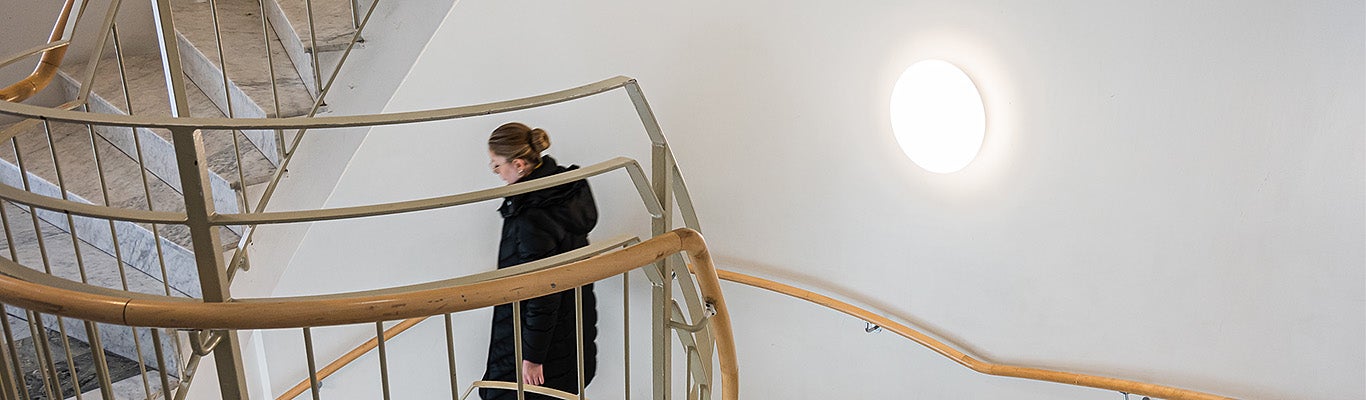
The right lighting solutions create functional and well-lit environments where people move and interact. For us, this means that light should be available where it is needed, when it is needed. In shared spaces such as entrances, corridors, and stairwells, sensor-controlled lighting is a common choice for adapting lighting operation to the use of the space. The lighting should provide visual comfort, be glare-free, and deliver uniform light distribution that makes navigation easy. By implementing smart lighting controls, energy consumption may be reduced depending on the installation, usage patterns, and control strategy without compromising the intended lighting function.
What Is Property Lighting?
Property lighting refers to the complete lighting system for a building’s shared interior and exterior areas. It is a broad term that covers everything from functional garage lighting to decorative façade lighting for residential buildings. The goal is always to create a functional lighting environment designed for long-term use with long service life and appropriate operating costs. Therefore, choosing luminaires with the appropriate IP rating and impact-resistant construction is essential for reducing future maintenance requirements.
Which Lighting Solutions Are Suitable for Properties and Residential Buildings?
The choice of luminaires depends entirely on the function and character of the space, ranging from robust bulkhead luminaires to LED floodlights for façade illumination. LED technology is today a widely used lighting technology due to long service life and low energy use relative to light output, which can reduce maintenance requirements.
In corridors and common areas, recessed LED panels or sleek bulkhead luminaires, suitable for both ceilings and walls, are often ideal for creating uniform light distribution. Outdoors, floodlights work well for illuminating large areas, while bollard and post-top luminaires are suitable for pathways. With the phase-out of fluorescent lighting, older fluorescent luminaires need to be replaced, and transitioning to modern LED solutions is an option that can provide long service life and low energy use, depending on product selection and installation. Lighting for residential and commercial properties simply requires modern solutions.
Why Choose Property Lighting from Aura Light?
We focus on service life, lighting control technology, and design for long-term use, with luminaires developed and manufactured for Nordic conditions.
Long Service Life: Our luminaires have a long service life, which can reduce the frequency of light source replacements over time and contribute to a low total cost of ownership, depending on operating conditions.
Smart Lighting Control: We use technologies such as ActiveAhead for wireless, self-learning lighting control that adapts to how spaces are actually used.
Visual Comfort: We prioritize glare-free lighting with uniform light distribution and high colour rendering (CRI) to create pleasant environments.
Safety and Security: Our products are robust and reliable, designed to enhance safety and security in and around the property.
Would you like help finding a lighting solution that suits your property or business? Contact Aura Light – we are happy to provide expert advice and help you choose the right property lighting solution.
Frequently Asked Questions About Property Lighting
What is important to consider when choosing property lighting?
Focus on long service life, low energy consumption, low maintenance requirements, and the correct technical specifications, such as IP rating and impact resistance (IK rating).
How can energy-efficient property lighting be achieved?
Use LED luminaires and implement smart lighting controls with sensors, such as motion detectors and daylight sensors, to ensure lighting is provided only when needed.
What requirements apply to property lighting?
Requirements vary, but often include regulations concerning emergency lighting, evacuation routes, and, in some cases, specific illumination levels according to standards and building regulations.
What colour temperature is recommended?
In general, a neutral white light (approximately 4000 K) is recommended for common areas to create a bright and alert atmosphere. A warm white light (approximately 3000 K) can be used where a more welcoming and comfortable ambience is desired.